Middle East Drilling Rig Transportation Market Analysis and Forecast by Size, Share, Growth, Trends 2031
Middle East Drilling Rig Transportation Market Size and Forecast (2021 - 2031), Regional Share, Trend, and Growth Opportunity Analysis Report Coverage: By Location (Onshore and Offshore), Transportation Mode (Seaway and Roadway), and Country
- Report Date : Jun 2025
- Report Code : TIPRE00040942
- Category : Automotive and Transportation
- Status : Published
- Available Report Formats :


- No. of Pages : 120
The Middle East drilling rig transportation market size is projected to reach US$ 799.57 million by 2031 from US$ 526.72 million in 2024. The market is expected to register a CAGR of 6.28% during 2025–2031. Growing investments for natural gas production capacity expansion are likely to bring new key trends to the market in the coming years.
Drilling Rig Transportation Market Analysis
Investments in the oil and gas field prevail as one of the main factors driving the demand for drilling rig transportation services. The oil sector alone accounts for 40% of the total GDP in Saudi Arabia, whereas it accounts for 30% of the total GDP in the UAE. Such investments lead to new exploration and production projects in the region. In addition, increasing energy demand and rise in oil and gas field exploration activities across the region are anticipated to be the key driving factors in the market. Moreover, increasing investments in shale gas exploration and production is projected to be the key opportunity for the key players operating in the market.
Drilling Rig Transportation Market Overview
Drilling rig transportation services play an important role in the oil and gas industry in the Middle East. These services are essential to ensure the efficient movement of onshore and offshore rigs from one site to another. The ecosystem begins with rig manufacturers, providers, and rental service providers. Rig manufacturers and providers such as ADES International Holding PLC, Arabian Drilling Company, Arabian Rig Manufacturing, ADES Holding, ADNOC Drilling, Lamprell, and Shelf Drilling provide drilling rigs and drilling services to end users. Apart from manufacturers, drill rental providers also play an important role in the ecosystem. Many oil and gas companies opt for rental services instead of purchasing the whole new equipment, which helps them minimize operational costs. NOV, SAB EST, Al Marwan Heavy Machinery, and Arabian Oilfield Supplies & Services are a few of the rig rental and drilling service providers in the Middle East.
The second node in the ecosystem is transportation. A few of the rig transportation companies in the Middle East are Gulf Haulage Rigmove (GH Holding Co.), Asateel Transportation, Abr Al Sahraa Company, Amirco, Golden Argo, Gulf Sanad General Contracting Est., SALEH AYED BALHARITH EST. (SAB), MOD Rig Move Co., Vortex Arabia, OFSAT Limited, OFSAT Saudia, ADNOC Drilling Company PJSC, Zararah Transporting and Maintenance Con, SMGT, AFEX, and Khalid Saeed Al Hajri Trading Company. During transportation to or from onshore sites, drilling rigs are disassembled and loaded on heavy trucks and trailers. On the other hand, they are loaded in heavy lift vessels and semi-submersible vessels when carrying to or from an offshore project. In offshore projects, road transportation is also used for the transportation of rigs from the manufacturer or rental service provider to the ports. Jebel Ali, Dammam, and Ras Laffan are a few of the notable ports in the Middle East, which handle cargo loading processes. For transferring rigs, port operators use heavy lift cranes and other material handling equipment. After the loading of cargo, the drilling rig is transported to the desired project site. After reaching the site, drilling rigs are then assembled for field operations.
The third and last node of the ecosystem is the end user. End users of drilling rig manufacturers are oil and gas companies such as Saudi Aramco, Qatar Petroleum, Abu Dhabi National Oil Company (ADNOC), Iraq National Oil Company, BP Plc, and Shell. Some of the drilling service providers operating in the region also provide oil production services to oil and gas companies across the globe. Thus, drilling service providers also serve as prominent end users in the ecosystem in addition to oil and gas companies.
Customize Research To Suit Your Requirement
We can optimize and tailor the analysis and scope which is unmet through our standard offerings. This flexibility will help you gain the exact information needed for your business planning and decision making.
Middle East Drilling Rig Transportation Market: Strategic Insights


Naveen
Have a question?
Naveen will walk you through a 15-minute call to present the report’s content and answer all queries if you have any.
 Speak to Analyst
Customize Research To Suit Your Requirement
We can optimize and tailor the analysis and scope which is unmet through our standard offerings. This flexibility will help you gain the exact information needed for your business planning and decision making.
Middle East Drilling Rig Transportation Market: Strategic Insights
Naveen
Have a question?
Naveen will walk you through a 15-minute call to present the report’s content and answer all queries if you have any.
Speak to Analyst
Drilling Rig Transportation Market Drivers and Opportunities
Growing Oil and Gas Field Exploration Activities
The Middle East is one of the most hydrocarbon-rich regions across the globe. Exploration and production activities are on the rise across the region to maximize their potential. As a result, some of the largest economies in the region, such as Saudi Arabia, UAE, Qatar, and Kuwait, are taking various initiatives to increase their production capacity, explore new oil and gas fields, and meet global energy demand. Government-owned companies such as Saudi Aramco and Abu Dhabi National Oil Company are investing heavily to expand their business and production activities. For instance, in July 2024, the government of Saudi Arabia announced the discovery of seven oil fields in the country’s Eastern Province. In April 2025, the government announced the discovery of another seven oil fields in the same area. In May 2024, Sharjah National Oil Corp. found new gas reserves in the Al Hadiba field, UAE. In September 2024, ADNOC announced a joint venture with two US-based companies to strengthen its position in unconventional drilling operations in the country. In October 2023, Iran’s Oil Minister revealed four new oil and gas fields in the country that added 2.6 billion barrels of oil to total country’s total reserves. In July 2024, Kuwait Petroleum Corporation (KPC) announced the discovery of new oil fields in the Al-Nokhatha field. Such exploration activities involve the use of drilling rigs for traversing deeper offshore fields, border zones, and previously untapped reservoirs. Thus, drilling rigs capable of transporting goods through deserts and difficult terrains are in greater demand.
Increasing Investments in Shale Gas Production
The shale gas industry in the Middle East is growing steadily owing to increased energy demands and economic diversification goals. Countries such as Saudi Arabia and the UAE are exploring the shale gas industry to meet the global and domestic demand. Shale gas is viewed as one of the alternatives to reduce the high dependency on crude oil for domestic power generation. Shale gas is commonly adopted as an important feedstock for methanol, ammonia, and other petrochemical processing plants. The government of Saudi Arabia is investing heavily in the industrial sector as part of its Saudi Vision 2030 strategy. As industrialization in the Middle Eastern countries grows, the demand for efficient power generation fuels will increase. Thus, governments across the region are taking various initiatives to develop the shale gas infrastructure. For instance, in January 2025, the government of Iran announced an investment of US$ 100–120 billion to increase the oil and gas production capacity as a part of its Seven National Development Plan (2022–2026). In July 2024, Saudi Arabia announced plans to invest ~US$ 100 billion to become the world’s third-largest shale gas producer by 2030. In February 2025, Gordon Technologies subsidiary of ADNOC Drilling, announced its plans to expand its business across the region to tap into unconventional gas deposits. Thus, owing to such government and private company initiatives, the demand for drilling services for shale gas is expected to increase. This increased demand for drilling services is projected to expand drilling rig transportation services during the forecast period.
Drilling Rig Transportation Market Report Segmentation Analysis
The key segments that contributed to the derivation of the Middle East drilling rig transportation market analysis are location and transportation mode.
- In terms of location, the Middle East drilling rig transportation market is segmented into onshore and offshore. The onshore segment held the larger share of the market in 2024.
- Based on transportation mode, the Middle East drilling rig transportation market is categorized into roadway and seaway. The roadway segment dominated the market in 2024.
Drilling Rig Transportation Market Share Analysis by Geography
The geographical scope of the drilling rig transportation market report offers a detailed country-level analysis in the Middle East. Saudi Arabia is the major country witnessing significant growth in the drilling rig transportation market owing to the rise in demand for rig transportation in the region. In addition, countries such as Saudi Arabia, Iraq, Iran, and the UAE are undertaking notable oil and gas capacity expansion projects. For instance, in April 2023, Baker Hughes announced a deal with QatarEnergy to provide equipment for the expansion of the North Field South (NFS) Project. The government is aiming to expand the country's capacity to 126 million tons per annum by 2027. Further, in June 2024, Saudi Aramco announced a new expansion contract for Jafurah Shale and the Master Gas System. The company invested US$ 25 billion to position Saudi Arabia as a top LNG-producing country by 2030. Further, BP Plc announced investments of US$ 25 billion in Iraq's Kirkuk oil and gas.
In addition, the government of Iraq is taking various initiatives to attract foreign direct investments in the oil sector. As a result, global oil and energy companies are undertaking geographical expansion activities in Iraq. In April 2024, United Energy Group Ltd announced the receiving of a contract to develop the Al-Faw oil field in Iraq. In addition, in May 2024, ZhenHua, Anton Oilfield Services, and Sinopec announced a new contract with the government of Iraq to develop the Abu Khaymah oilfield. Thus, owing to increased government investments and the entry of global players in the development of oil fields in the region, the demand for drilling services is expected to increase, which will subsequently drive the drilling rig transportation market during the forecast period.
Middle East Drilling Rig Transportation Market Report Scope
Drilling Rig Transportation Market Report Coverage and Deliverables
The "Middle East drilling Rig Transportation Market Size and Forecast (2021–2031)" report provides a detailed analysis of the market covering below areas:
- Middle East drilling rig transportation market size and forecast at country levels for all the key market segments covered under the scope
- Middle East drilling rig transportation market trends, as well as market dynamics such as drivers, restraints, and key opportunities
- Detailed PEST and SWOT analysis
- Middle East drilling rig transportation market analysis covering key market trends, country framework, major players, regulations, and recent market developments
- Industry landscape and competition analysis covering market concentration, heat map analysis, prominent players, and recent developments for the Middle East drilling rig transportation market
- Detailed company profiles

Report Coverage
Revenue forecast, Company Analysis, Industry landscape, Growth factors, and Trends

Segment Covered
This text is related
to segments covered.

Regional Scope
North America, Europe, Asia Pacific, Middle East & Africa, South & Central America

Country Scope
This text is related
to country scope.
Frequently Asked Questions
Motorized rigging system is expected to dominate the market in the forecast period, as motorized rigging systems have been able to penetrate the developed nations owing to its higher investment cost with its additional electric motors and variable speed drives.
Many theatres are adopting hybrid rigging systems which consists of partial manually operated and motorized rigging systems. This helps in keeping the initial setup cost in the budget of the customers. Thus, hybrid implementation of rigging system can prove to be a future opportunity that would drive the stage and scenery equipment market in the near future.
The growth of the stage and scenery equipment market is primarily attributed to the significant rise in demand for automated rigging systems in theatres and increasing demand for safety and space concerns. Moreover, the strategic partnerships and mergers among the industry participants is a trend that is likely to boost the growth of the market
The Insight Partners performs research in 4 major stages: Data Collection & Secondary Research, Primary Research, Data Analysis and Data Triangulation & Final Review.
- Data Collection and Secondary Research:
As a market research and consulting firm operating from a decade, we have published many reports and advised several clients across the globe. First step for any study will start with an assessment of currently available data and insights from existing reports. Further, historical and current market information is collected from Investor Presentations, Annual Reports, SEC Filings, etc., and other information related to company’s performance and market positioning are gathered from Paid Databases (Factiva, Hoovers, and Reuters) and various other publications available in public domain.
Several associations trade associates, technical forums, institutes, societies and organizations are accessed to gain technical as well as market related insights through their publications such as research papers, blogs and press releases related to the studies are referred to get cues about the market. Further, white papers, journals, magazines, and other news articles published in the last 3 years are scrutinized and analyzed to understand the current market trends.
- Primary Research:
The primarily interview analysis comprise of data obtained from industry participants interview and answers to survey questions gathered by in-house primary team.
For primary research, interviews are conducted with industry experts/CEOs/Marketing Managers/Sales Managers/VPs/Subject Matter Experts from both demand and supply side to get a 360-degree view of the market. The primary team conducts several interviews based on the complexity of the markets to understand the various market trends and dynamics which makes research more credible and precise.
A typical research interview fulfils the following functions:
- Provides first-hand information on the market size, market trends, growth trends, competitive landscape, and outlook
- Validates and strengthens in-house secondary research findings
- Develops the analysis team’s expertise and market understanding
Primary research involves email interactions and telephone interviews for each market, category, segment, and sub-segment across geographies. The participants who typically take part in such a process include, but are not limited to:
- Industry participants: VPs, business development managers, market intelligence managers and national sales managers
- Outside experts: Valuation experts, research analysts and key opinion leaders specializing in the electronics and semiconductor industry.
Below is the breakup of our primary respondents by company, designation, and region:
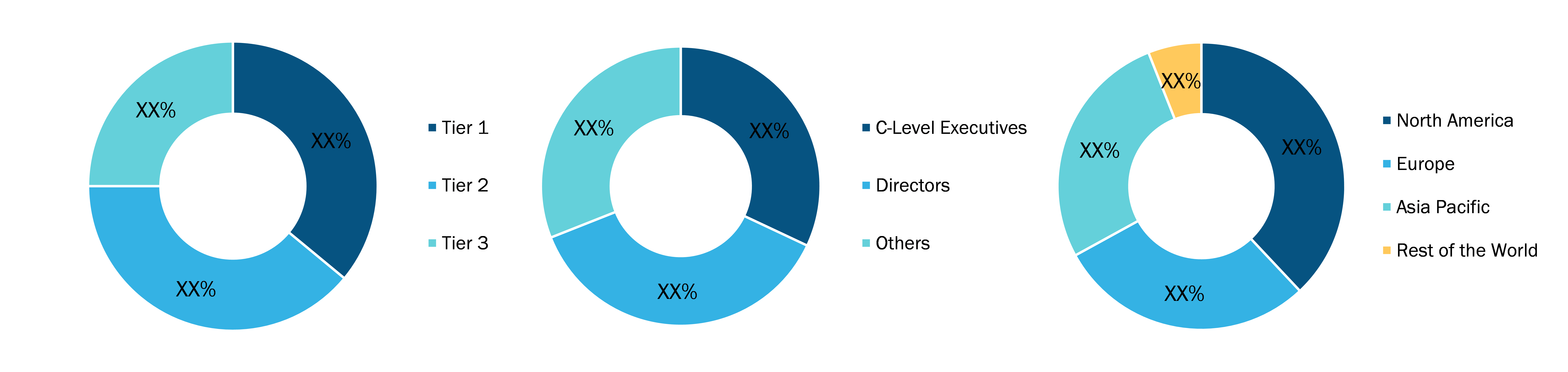
Once we receive the confirmation from primary research sources or primary respondents, we finalize the base year market estimation and forecast the data as per the macroeconomic and microeconomic factors assessed during data collection.
- Data Analysis:
Once data is validated through both secondary as well as primary respondents, we finalize the market estimations by hypothesis formulation and factor analysis at regional and country level.
- 3.1 Macro-Economic Factor Analysis:
We analyse macroeconomic indicators such the gross domestic product (GDP), increase in the demand for goods and services across industries, technological advancement, regional economic growth, governmental policies, the influence of COVID-19, PEST analysis, and other aspects. This analysis aids in setting benchmarks for various nations/regions and approximating market splits. Additionally, the general trend of the aforementioned components aid in determining the market's development possibilities.
- 3.2 Country Level Data:
Various factors that are especially aligned to the country are taken into account to determine the market size for a certain area and country, including the presence of vendors, such as headquarters and offices, the country's GDP, demand patterns, and industry growth. To comprehend the market dynamics for the nation, a number of growth variables, inhibitors, application areas, and current market trends are researched. The aforementioned elements aid in determining the country's overall market's growth potential.
- 3.3 Company Profile:
The “Table of Contents” is formulated by listing and analyzing more than 25 - 30 companies operating in the market ecosystem across geographies. However, we profile only 10 companies as a standard practice in our syndicate reports. These 10 companies comprise leading, emerging, and regional players. Nonetheless, our analysis is not restricted to the 10 listed companies, we also analyze other companies present in the market to develop a holistic view and understand the prevailing trends. The “Company Profiles” section in the report covers key facts, business description, products & services, financial information, SWOT analysis, and key developments. The financial information presented is extracted from the annual reports and official documents of the publicly listed companies. Upon collecting the information for the sections of respective companies, we verify them via various primary sources and then compile the data in respective company profiles. The company level information helps us in deriving the base number as well as in forecasting the market size.
- 3.4 Developing Base Number:
Aggregation of sales statistics (2020-2022) and macro-economic factor, and other secondary and primary research insights are utilized to arrive at base number and related market shares for 2022. The data gaps are identified in this step and relevant market data is analyzed, collected from paid primary interviews or databases. On finalizing the base year market size, forecasts are developed on the basis of macro-economic, industry and market growth factors and company level analysis.
- Data Triangulation and Final Review:
The market findings and base year market size calculations are validated from supply as well as demand side. Demand side validations are based on macro-economic factor analysis and benchmarks for respective regions and countries. In case of supply side validations, revenues of major companies are estimated (in case not available) based on industry benchmark, approximate number of employees, product portfolio, and primary interviews revenues are gathered. Further revenue from target product/service segment is assessed to avoid overshooting of market statistics. In case of heavy deviations between supply and demand side values, all thes steps are repeated to achieve synchronization.
We follow an iterative model, wherein we share our research findings with Subject Matter Experts (SME’s) and Key Opinion Leaders (KOLs) until consensus view of the market is not formulated – this model negates any drastic deviation in the opinions of experts. Only validated and universally acceptable research findings are quoted in our reports.
We have important check points that we use to validate our research findings – which we call – data triangulation, where we validate the information, we generate from secondary sources with primary interviews and then we re-validate with our internal data bases and Subject matter experts. This comprehensive model enables us to deliver high quality, reliable data in shortest possible time.
 Get Free Sample For