Europe Tonic Water Market Strategies, Top Players, Growth Opportunities, Analysis and Forecast by 2031
Europe Tonic Water Market Size and Forecast (2021 - 2031), Regional Share, Trend, and Growth Opportunity Analysis Report Coverage: By Type (Plain and Flavored), Category (Low/No Sugar and Regular), End User (On-Trade and Off-Trade), and Country
- Report Date : May 2025
- Report Code : TIPRE00040915
- Category : Food and Beverages
- Status : Published
- Available Report Formats :


- No. of Pages : 100
The Europe tonic water market size was valued at US$ 1.13 billion in 2024 and is projected to reach US$ 1.76 billion by 2031; it is expected to register a CAGR of 6.5% during 2025–2031. The rising popularity of low/no sugar beverages is a prominent trend in the market.
Europe Tonic Water Market Analysis
Tonic water is a popular cocktail mixer prominently used in gin-based cocktails. It has a distinct bitter flavor due to the presence of quinine, which pairs well with gin and imparts a refreshing taste to the cocktail. Tonic water has evolved beyond its traditional form, with many premium and flavored options now available. These tonics often incorporate botanicals and different sweeteners, expanding the flavor range and appeal.
The growth of the tonic water market in Europe is primarily driven by a surge in consumer interest in health-conscious, low-alcohol, and non-alcoholic beverages. Younger, health-aware consumers are increasingly seeking lighter, flavorful drinks without compromising on taste, leading to a rise in flavored tonic waters and their use in non-alcoholic beverages. This trend is also supported by the expansion of craft distilleries and a broader cultural exploration of diverse flavors, adding to the appeal of tonic water as a versatile mixer in both alcoholic and non-alcoholic drinks. ​
The booming e-commerce sector presents strong growth opportunities for the tonic water market across Europe. With the increasing popularity of online shopping, particularly in the food and beverages segment, tonic water brands can leverage e-commerce platforms to expand their market presence and reach an extended consumer base.
Europe Tonic Water Market Overview
The Europe tonic water market is primarily driven by the increasing popularity of gin and tonic cocktails, particularly in gin-centric countries such as the UK and Germany. Consumers are also gravitating toward premium and low-sugar tonic water options, aligning with broader health and wellness trends. Innovations in flavor profiles with the incorporation of elderflower, cucumber, and grapefruit flavors have further fueled consumer interest, especially among younger, health-conscious drinkers seeking unique and refreshing options. The off-trade segment, encompassing retail sales, continues to dominate the market, while the on-trade segment, including bars and restaurants, is also witnessing significant growth due to the expanding cocktail and party culture. Leading companies such as Fever-Tree and Schweppes are capitalizing on these trends by offering high-quality, botanically inspired mixers.
Customize Research To Suit Your Requirement
We can optimize and tailor the analysis and scope which is unmet through our standard offerings. This flexibility will help you gain the exact information needed for your business planning and decision making.
Europe Tonic Water Market: Strategic Insights


Shejal
Have a question?
Shejal will walk you through a 15-minute call to present the report’s content and answer all queries if you have any.
 Speak to Analyst
Customize Research To Suit Your Requirement
We can optimize and tailor the analysis and scope which is unmet through our standard offerings. This flexibility will help you gain the exact information needed for your business planning and decision making.
Europe Tonic Water Market: Strategic Insights
Shejal
Have a question?
Shejal will walk you through a 15-minute call to present the report’s content and answer all queries if you have any.
Speak to Analyst
Europe Tonic Water Market Drivers and Opportunities
Innovations in Flavors
Consumers are increasingly seeking premium and unique experiences in everyday beverages. In response to the evolving consumer expectations, tonic water manufacturers across the region are engaged in product development and innovation to attract a larger clientele and enhance their market position. Innovative flavors such as elderflower, cucumber, and grapefruit appeal to a wider range of consumers. In July 2023, Double Dutch, a UK-based premium tonic water and mixer brand, announced the launch of its new elderflower tonic water, with an aim to cater to the elevating consumer demand for innovative flavors. According to industry experts, consumers highly prefer fresh and fruity citrus flavors in Europe.
Proliferation of E-Commerce
Tonic water brands are leveraging e-commerce platforms to expand their market presence and reach an extended consumer base. These brands can directly connect with consumers by establishing an online presence, offering a seamless shopping experience and convenient delivery options, which is especially appealing to busy urban residents. The launch of a dedicated online platform specifically offering alcoholic beverages and mixers creates growth opportunities for the tonic water market players. In September 2023, the Britvic Mixers announced the launch of Indian Tonic Water in a multipack can packaging for the first time in a retail channel. The launch is expected to help retailers capitalize on the growth of at-home occasions. Introduction through retail channels helps manufacturers offer a curated selection of their premium tonic water brands, offering consumers a one-stop shop for their cocktail needs. In addition, the digital landscape allows tonic water brands to showcase their extensive product range, share cocktail recipes, and engage with consumers through interactive content and personalized recommendations. By harnessing the power of digital marketing and analytics, brands can target niche consumer segments and tailor their messaging to resonate with different preferences and occasions, driving awareness and loyalty.
Europe Tonic Water Market Report Segmentation Analysis
Key segments that contributed to the derivation of the Europe tonic water market analysis are type, category, and end user.
- Based on type, the market is segmented into plain and flavored. The flavored segment is expected to register a higher CAGR during the forecast period.
- Based on category, the market is bifurcated into low/no sugar and regular. The low/no sugar segment is expected to register a faster CAGR from 2025 to 2031.
- By end user, the Europe tonic water market is segmented into on-trade and off-trade. The off-trade segment dominated the market in 2024.
Europe Tonic Water Market Share Analysis by Country
Based on country, the Europe tonic water market is segmented into Germany, France, Italy, Spain, the UK, Sweden, the Netherlands, and the Rest of Europe. The market in Italy is expected to register the fastest CAGR from 2025 to 2031. In recent years, the popularity of gin has largely increased among young demographics and urban consumers. This trend has created a growing demand for premium tonic water brands that can enhance the botanical attributes of craft and artisanal gins, further driving innovations and competition within the market. The subsequent strategic initiatives such as mergers and acquisitions, partnerships, collaborations, and product launches further contribute to the market's growth in Italy. For instance, in February 2025, Velier entered into a partnership agreement with Fever-Tree to distribute its product in the Italian market. Italy's vibrant nightlife has played a crucial role in fueling the demand for tonic water. Bartenders and mixologists across the country are continuously experimenting with new flavor combinations and cocktail recipes, elevating the status of tonic water as an essential ingredient in contemporary mixology.
Europe Tonic Water Market Report Scope
Europe Tonic Water Market News and Recent Developments
The Europe tonic water market is evaluated by gathering qualitative and quantitative data post primary and secondary research, which includes important corporate publications, association data, and databases.
- Double Dutch introduces elderflower tonic water (Source: Press Release, July 2023)
- Britvic Indian Tonic Water expands its presence in retail with the launch of cans for the first time (Source: Press Release, Sept 2023)
- Gloucestershire Farm launches the first organic tonic water made in the UK and two new spirits (Source: Press Release, May 2022)
Europe Tonic Water Market Report Coverage and Deliverables
The "Europe Tonic Water Market Share and Forecast (2021–2031)" report provides a detailed analysis of the market covering below areas:
- Europe tonic water market trends and forecast for all the key market segments covered under the scope
- Europe tonic water market trends, as well as market dynamics such as drivers, restraints, and key opportunities
- Detailed Porter's Five Forces and SWOT analysis
- Europe tonic water market analysis covering key market trends, country framework, major players, regulations, and recent market developments.
- Industry landscape and competition analysis covering market concentration, heat map analysis, prominent players, and recent developments for the market
- Detailed company profiles

Report Coverage
Revenue forecast, Company Analysis, Industry landscape, Growth factors, and Trends

Segment Covered
This text is related
to segments covered.

Regional Scope
North America, Europe, Asia Pacific, Middle East & Africa, South & Central America

Country Scope
This text is related
to country scope.
Frequently Asked Questions
Government support for the development and deployment of robotics and rapid expansion in manufacturing industry are the major factors that propel the Global Collaborative Robots Market.
Advancement in Robotics Industry are impacting the Global Collaborative Robots, which is anticipated to play a significant role in the Global Collaborative Robots Market in the coming years.
The key players holding majority shares in the Global Collaborative Robots Market are Kuka AG, Yaskawa America Inc, Aubo (Beijing) Robotics Technology Co Ltd, Doosan Robotics Inc, Fanuc Corp,.
The Global Collaborative Robots Market was estimated to be US$ 1.15 billion in 2022 and is expected to grow at a CAGR of 28.9% during the forecast period 2022 - 2030.
The Global Collaborative Robots Market is expected to reach US 8.81 billion by 2030.
The incremental growth expected to be recorded for the Global Collaborative Robots Market during the forecast period is US$ 7.65 billion.
The Insight Partners performs research in 4 major stages: Data Collection & Secondary Research, Primary Research, Data Analysis and Data Triangulation & Final Review.
- Data Collection and Secondary Research:
As a market research and consulting firm operating from a decade, we have published many reports and advised several clients across the globe. First step for any study will start with an assessment of currently available data and insights from existing reports. Further, historical and current market information is collected from Investor Presentations, Annual Reports, SEC Filings, etc., and other information related to company’s performance and market positioning are gathered from Paid Databases (Factiva, Hoovers, and Reuters) and various other publications available in public domain.
Several associations trade associates, technical forums, institutes, societies and organizations are accessed to gain technical as well as market related insights through their publications such as research papers, blogs and press releases related to the studies are referred to get cues about the market. Further, white papers, journals, magazines, and other news articles published in the last 3 years are scrutinized and analyzed to understand the current market trends.
- Primary Research:
The primarily interview analysis comprise of data obtained from industry participants interview and answers to survey questions gathered by in-house primary team.
For primary research, interviews are conducted with industry experts/CEOs/Marketing Managers/Sales Managers/VPs/Subject Matter Experts from both demand and supply side to get a 360-degree view of the market. The primary team conducts several interviews based on the complexity of the markets to understand the various market trends and dynamics which makes research more credible and precise.
A typical research interview fulfils the following functions:
- Provides first-hand information on the market size, market trends, growth trends, competitive landscape, and outlook
- Validates and strengthens in-house secondary research findings
- Develops the analysis team’s expertise and market understanding
Primary research involves email interactions and telephone interviews for each market, category, segment, and sub-segment across geographies. The participants who typically take part in such a process include, but are not limited to:
- Industry participants: VPs, business development managers, market intelligence managers and national sales managers
- Outside experts: Valuation experts, research analysts and key opinion leaders specializing in the electronics and semiconductor industry.
Below is the breakup of our primary respondents by company, designation, and region:
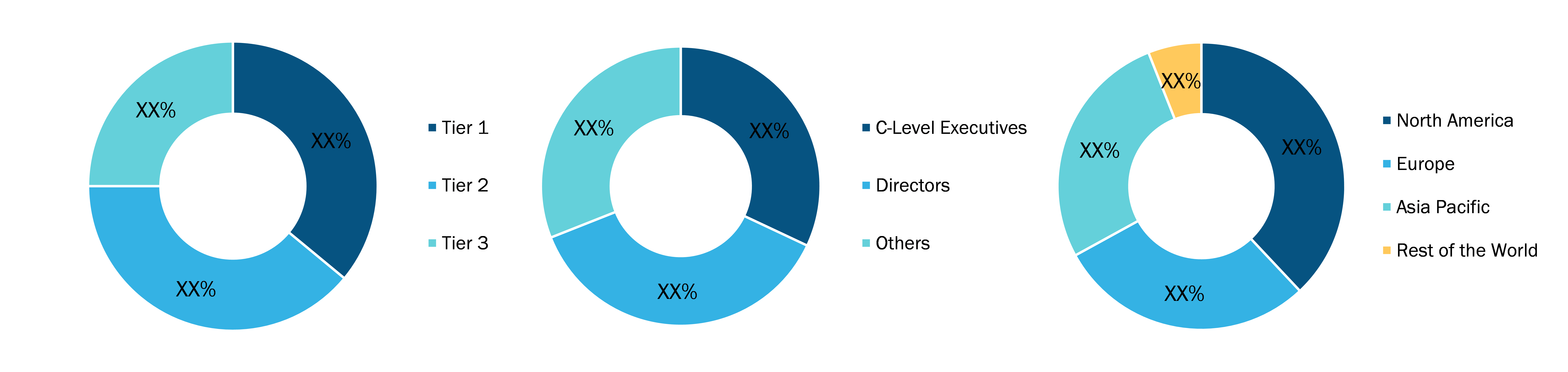
Once we receive the confirmation from primary research sources or primary respondents, we finalize the base year market estimation and forecast the data as per the macroeconomic and microeconomic factors assessed during data collection.
- Data Analysis:
Once data is validated through both secondary as well as primary respondents, we finalize the market estimations by hypothesis formulation and factor analysis at regional and country level.
- 3.1 Macro-Economic Factor Analysis:
We analyse macroeconomic indicators such the gross domestic product (GDP), increase in the demand for goods and services across industries, technological advancement, regional economic growth, governmental policies, the influence of COVID-19, PEST analysis, and other aspects. This analysis aids in setting benchmarks for various nations/regions and approximating market splits. Additionally, the general trend of the aforementioned components aid in determining the market's development possibilities.
- 3.2 Country Level Data:
Various factors that are especially aligned to the country are taken into account to determine the market size for a certain area and country, including the presence of vendors, such as headquarters and offices, the country's GDP, demand patterns, and industry growth. To comprehend the market dynamics for the nation, a number of growth variables, inhibitors, application areas, and current market trends are researched. The aforementioned elements aid in determining the country's overall market's growth potential.
- 3.3 Company Profile:
The “Table of Contents” is formulated by listing and analyzing more than 25 - 30 companies operating in the market ecosystem across geographies. However, we profile only 10 companies as a standard practice in our syndicate reports. These 10 companies comprise leading, emerging, and regional players. Nonetheless, our analysis is not restricted to the 10 listed companies, we also analyze other companies present in the market to develop a holistic view and understand the prevailing trends. The “Company Profiles” section in the report covers key facts, business description, products & services, financial information, SWOT analysis, and key developments. The financial information presented is extracted from the annual reports and official documents of the publicly listed companies. Upon collecting the information for the sections of respective companies, we verify them via various primary sources and then compile the data in respective company profiles. The company level information helps us in deriving the base number as well as in forecasting the market size.
- 3.4 Developing Base Number:
Aggregation of sales statistics (2020-2022) and macro-economic factor, and other secondary and primary research insights are utilized to arrive at base number and related market shares for 2022. The data gaps are identified in this step and relevant market data is analyzed, collected from paid primary interviews or databases. On finalizing the base year market size, forecasts are developed on the basis of macro-economic, industry and market growth factors and company level analysis.
- Data Triangulation and Final Review:
The market findings and base year market size calculations are validated from supply as well as demand side. Demand side validations are based on macro-economic factor analysis and benchmarks for respective regions and countries. In case of supply side validations, revenues of major companies are estimated (in case not available) based on industry benchmark, approximate number of employees, product portfolio, and primary interviews revenues are gathered. Further revenue from target product/service segment is assessed to avoid overshooting of market statistics. In case of heavy deviations between supply and demand side values, all thes steps are repeated to achieve synchronization.
We follow an iterative model, wherein we share our research findings with Subject Matter Experts (SME’s) and Key Opinion Leaders (KOLs) until consensus view of the market is not formulated – this model negates any drastic deviation in the opinions of experts. Only validated and universally acceptable research findings are quoted in our reports.
We have important check points that we use to validate our research findings – which we call – data triangulation, where we validate the information, we generate from secondary sources with primary interviews and then we re-validate with our internal data bases and Subject matter experts. This comprehensive model enables us to deliver high quality, reliable data in shortest possible time.
 Get Free Sample For