Oleochemicals Market Demand, Trends & Forecast by 2034
Oleochemicals Market Size and Forecast (2021 - 2034), Global and Regional Share, Trend, and Growth Opportunity Analysis Report Coverage: By Source (Palm Oil, Soy Oil, Coconut Oil, Tallow, Castor Oil, and Others), Type (Fatty Acid [Saturated and Unsaturated], Fatty Alcohols, Glycerin, Fatty Esters, Fatty Amines, FAME, and Others), Application (Crop Protection, Food Emulsifiers, Surfactants, Personal Care and Cosmetics, Stabilizers, Oil and Gas, Polymers, Lubricants and Fuel Additives, Feed, and Others), and End Use (Pharmaceuticals and Nutraceuticals, Personal Care and Cosmetics, Food and Beverage, Paints and Coatings, Lubricants, Industrial and Institutional Cleaners, Textiles, Plastic, Homecare, and Others)
Historic Data: 2021-2024 | Base Year: 2025 | Forecast Period: 2026-2034- Status : Published
- Report Code : TIPRE00003429
- Category : Chemicals and Materials
- No. of Pages : 617
- Available Report Formats :



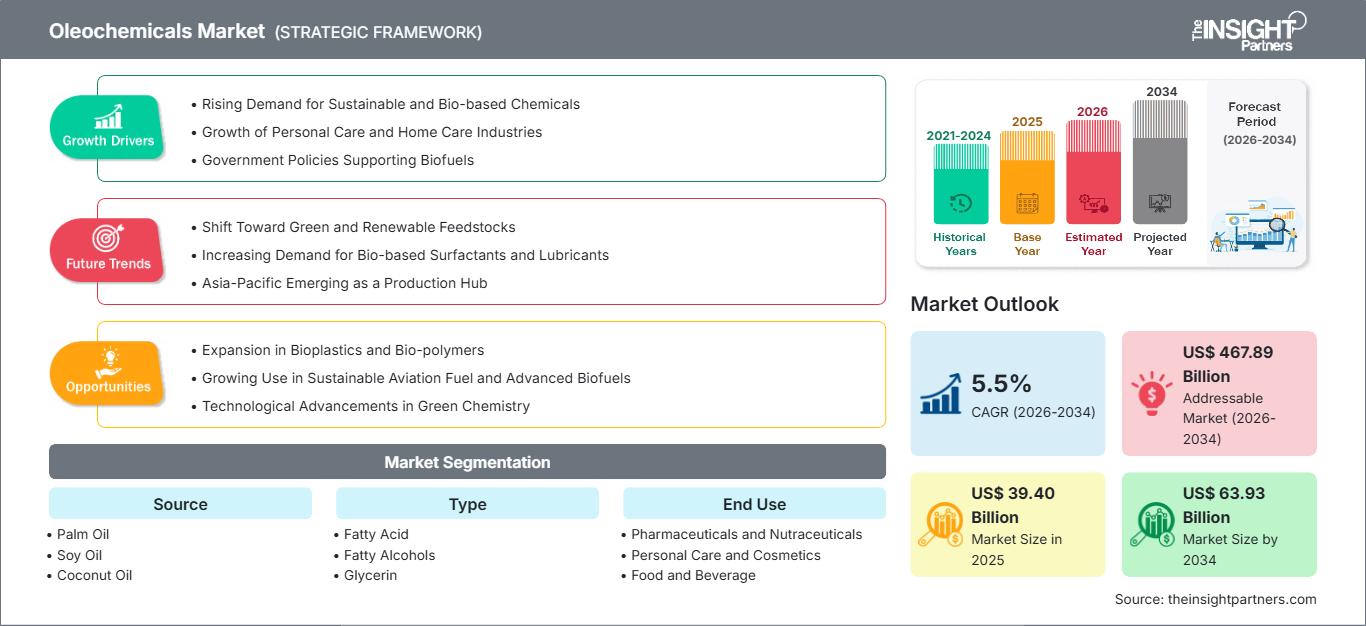
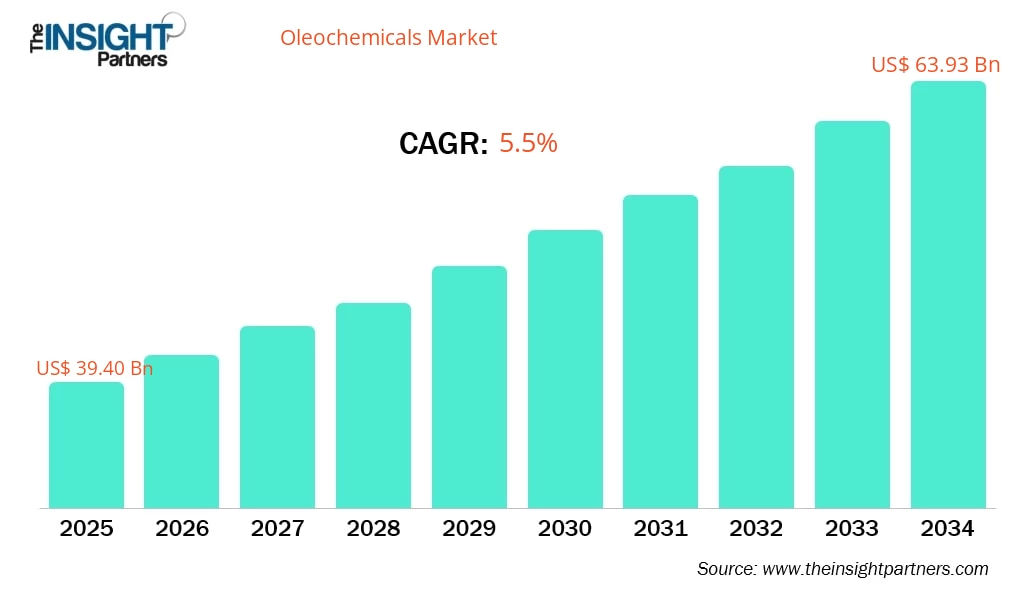
The oleochemicals market size is projected to reach US$ 63.93 billion by 2034 from US$ 39.40 billion in 2025. The market is expected to register a CAGR of 5.5% during 2026–2034.
Oleochemicals Market Analysis
The increasing demand for sustainable, multifunctional, and high-performance chemical products has prompted the use of oleochemicals in industries. The major end users are in the personal care manufacturers, food processors, pharmaceuticals, industrial applications, and the manufacturers of personal label products because oleochemicals can ensure consistent quality, functional performance, predictable formulations, and easier management of ingredients. The expansion of modern industrial infrastructure, the development of large cities, the increasing disposable incomes, and the surging demand for products that are environmentally friendly and of bio-based products contribute to the market growth. The innovations in renewable feedstock, clean-label and certified sustainable formula, and specialty products (biodegradable surfactants and glycerin derivatives) have increased consumer and business engagement. It enhances market attractiveness because manufacturers use advanced processing technologies, automation of blending and refining, improved product stability, and sustainable packaging. Oleochemicals continue to be important in mainstream and specialty and export-driven industrial markets due to their role in ensuring consistency in product performance, simplifying the formulation process, and responding to changing environmental and regulatory requirements.
Oleochemicals Market Overview
The natural oils used in the production of oleochemicals include palm, coconut, and soy oils with controlled processing factors, quality standardization, and long shelf life to maintain functional properties in soaps, detergents, cosmetics, lubricants, and food-grade use. Premium oleochemical products are devoted to renewable feedstocks, transparent labelling, and responsibly sourced raw materials, as these are aimed at sustainability promises. Current market trends are digital procurement platforms, rising demand for bio-based and specialty products, growing research interest in formulations that are environmentally friendly, and the growth of environmental regulation. North America and Europe are developed markets with high brand competition and penetration on the use of private labels. The fastest-growing region is APAC, contributed by industrial development, urbanization, increased consciousness about sustainable chemicals, introduction to world standards, and the emergence of regional manufacturing and export systems.
Customize This Report To Suit Your Requirement
Get FREE CUSTOMIZATIONOleochemicals Market: Strategic Insights
-
Get Top Key Market Trends of this report.This FREE sample will include data analysis, ranging from market trends to estimates and forecasts.
Oleochemicals Market Drivers and Opportunities
Market Drivers:
- Rising Demand for Sustainable and Bio-Based Ingredients: Increasing environmental awareness and compulsory measures are compelling manufacturers to substitute petrochemicals with renewable, biodegradable oleochemicals in personal care, food, and industrial products.
- Expanding End-Use Industries: The growing demand for soaps, detergents, cosmetics, pharmaceuticals, and industrial products is driving the demand for oleochemicals with uniform performance and functionality.
- Technological Advancements in Processing: Refining, blending, and automation can be improved to create high-quality oleochemical products, cut the costs of production, and facilitate their wider usage.
Market Opportunities:
- Rising Popularity of Specialty and High-Performance Products: The need to use bio-based surfactants, glycerin derivatives, and specialty fatty acids creates an opportunity for manufacturers to develop new value-adding formulations.
- Growth in Emerging Markets: The growth in industrialization, urbanization, and disposable incomes in APAC, Latin America, and Africa is opening new opportunities for oleochemicals in manufacturing, personal care, and food processing.
- Focus on Circular Economy and ESG Compliance: The trend toward sustainable sourcing, traceable supply chains, and low-impact production can be exploited by manufacturers to meet the global environmental, social, and governance (ESG) objectives.
Oleochemicals Market Report Segmentation Analysis
The oleochemicals market is divided into different segments to give a clearer view of its growth potential and the latest trends. Below is the standard segmentation approach used in industry reports:
By Source:
- Palm Oil: A flexible and economical vegetable oil that comes from the fruit of the oil palm tree is utilized in soaps, detergents, cosmetics, food-grade products, and industrial usage in emulsifying, moisturizing, and surfactant qualities.
- Soy Oil: A vegetable oil derived from soybeans, which is popular in biodiesel, personal care, food processing, and industrial formulations due to its high stability, content of fatty acids, and eco-friendly and renewable profile.
- Coconut Oil: A tropical oil derived from coconuts that is appreciated as antimicrobial, moisturizing, foaming, in personal care, soaps, detergents, as well as specialty industrial oleochemical items.
- Tallow: Animal fat (usually beef or mutton) is rendered into a form that is used in soaps, lubricating oils, candles, and certain oleochemicals because it contains saturated fatty acids and is highly stable.
- Castor Oil: A natural oil derived by the extraction process of castor beans and used in cosmetics, lubricants, pharmaceuticals, and specialty chemical purposes due to the presence of high ricinoleic acid, biodegradability, and its use in coatings and plastics.
- Others: It contains sunflower, rapeseed, and palm kernel derivatives, which find applications in personal care, industry, and food markets because of their distinctive fatty acid compositions, renewability, and specialty functional characteristics.
By Type:
- Fatty Acid
- Saturated
- Unsaturated
- Fatty Alcohols
- Glycerin
- Fatty Esters
- Fatty Amines
- FAME
- Others
By Application:
- Crop Protection
- Food Emulsifiers
- Surfactants
- Personal Care and Cosmetics
- Stabilizers
- Oil and Gas
- Polymers
- Lubricants and Fuel Additives
- Feed
- Others
By End Use:
- Pharmaceuticals and Nutraceuticals
- Personal Care and Cosmetics
- Food and Beverage
- Paints and Coatings
- Lubricants
- Industrial and Institutional Cleaners
- Textile
- Plastic
- Homecare
- Others
By Geography:
- North America
- Europe
- Asia Pacific
- Middle East & Africa
- South & Central America
Oleochemicals Market Report Scope
| Report Attribute | Details |
|---|---|
| Market size in 2025 | US$ 39.40 Billion |
| Market Size by 2026-2034 | US$ 63.93 Billion |
| Global CAGR (2026 - 2034) | 5.5% |
| Historical Data | 2021-2024 |
| Forecast period | 2026-2034 |
| Segments Covered |
By Source
|
| Regions and Countries Covered |
North America
|
| Market leaders and key company profiles |
|
Oleochemicals Market Players Density: Understanding Its Impact on Business Dynamics
The Oleochemicals Market is growing rapidly, driven by increasing end-user demand due to factors such as evolving consumer preferences, technological advancements, and greater awareness of the product's benefits. As demand rises, businesses are expanding their offerings, innovating to meet consumer needs, and capitalizing on emerging trends, which further fuels market growth.
Oleochemicals Market Share Analysis by Geography
The process of intense industrialization and increasing disposable income is fueling investment in contemporary manufacturing, refining, and distribution networks that have facilitated the uptake of oleochemicals. In Asia Pacific, Latin America, the Middle East, and Africa, the development of industrial infrastructure, growing urbanization, and the increasing requirements of sustainable and bio-based chemical solutions are accelerating the development of the market.
The oleochemicals market growth differs in each region due to the rate of economic development and consumer preferences. Below is a summary of market share and trends by region:
1. North America
- Market Share: Holds a significant portion of the global market
- Key Drivers:
- An increase in the demand for bio-based, sustainable, and renewable chemical solutions in the personal care, food, and industrial sectors.
- Well-established regulatory authorities and a shift to green, non-toxic products by consumers.
- Developed manufacturing, distribution, and e-commerce networks that guarantee a steady supply of oleochemical products.
- Trends: Surging use of specialty and high-performance oleochemicals such as biodegradable surfactants, glycerin derivatives, and sustainable packaging.
2. Europe
- Market Share: A large market with well-established industrial and regulatory systems.
- Key Drivers:
- Increased need for certified sustainable, bio-based oleochemicals in personal care, food, and industrial applications.
- Rising emphasis on traceable supply chains and non-toxic, additive-free, and consumer and business interests.
- Intense competition in the specialty chemical manufacturers and long-established distribution channels to promote product adoption.
- Trends: Increased production of eco-friendly, organic, and high-performance oleochemicals, supported by environmental sustainability, ESG, and circular economy activities.
3. Asia Pacific
- Market Share: The largest and fastest-growing regional market
- Key Drivers:
- Rapid industrialization, urbanization, and increasing disposable incomes drive up demand for personal care, food, and industrial oleochemical applications.
- Surging use of renewable and bio-based chemicals as companies and consumers move to sustainable products.
- Development of regional manufacturing, processing, and distribution channels to make products available.
- Trends: The manufacturers are concentrating on the local formulations, specialty products, and scalable production solutions to address the changing needs of consumers and industries.
4. Middle East and Africa
- Market Share: A steadily progressing market with strong growth potential
- Key Drivers:
- Increasing industrial growth and urbanization are driving demand for oleochemicals in personal care, food, and industrial products.
- Modern manufacturing, distribution, and industrial infrastructural development facilitate the growth of the market.
- Trends: The increasing attention to sustainable, renewable, and high-quality oleochemicals to comply with regulatory compliance and environmental awareness campaigns.
5. South and Central America
- Market Share: A smaller but steadily expanding market
- Key Drivers:
- Construction of industrial and manufacturing centers is on the rise, which is making oleochemical products more accessible.
- Increasing attraction to renewable and sustainable chemical solutions in the food, personal care, and industry industries.
- Trends: Steady growth, due to urbanization, increasing disposable incomes, and the slow uptake of bio-based and specialty oleochemicals in the manufacturing and personal care sectors.
High Market Density and Competition
Competition is intense due to the presence of established players such as Arkema SA, BASF SE, Godrej Industries Ltd, Oleon NV, Kao Corp, and IOI Corporation Berhad.
This high level of competition urges companies to stand out by:
- Importing high-quality, superior oleochemical products that provide uniform functional performance, stability, and purity over applications in the personal care, food, and industrial markets, to meet the needs of the most demanding manufacturers and final users.
- Enhancing safety and transparency by providing strict quality control, traceable sourcing, and RSPO (palm oil derivatives), allergen-free, and non-toxic formulations, reducing the risk of contamination, and increasing the consumer/business confidence.
- Implementation of sustainable and environmental friendly practices, such as biodegradable formulations, low energy and water consumption production, use of renewable feedstocks, and low carbon footprint in line with the changing environmental regulations.
Opportunities and Strategic Moves
- Discover the circular economy and the valorization of waste, upcycling by-products, residual oils, or converting waste into new oleochemical products, lowering the cost of raw materials and environmental impact.
- Forge long-term collaborations with manufacturers of personal care, food, and industrial products to jointly develop specialty, high-performance, and sustainable oleochemical solutions that address the changing trends.
- Aligning with regulatory departments, logistics companies, and distributors to harmonize safe handling, sustainable packaging, and optimal storage, usage, and shelf-life management, improving product reliability and consumer confidence.
Major companies operating in the oleochemicals market are:
- BASF SE
- Godrej Industries Ltd
- Arkema SA
- Evyap Life Chemistry
- KLK OLEO
- Fairchem Organics Limited
- Oleon NV
- JNJ OIL INDUSTRIES, INC.
- IOI Corporation Berhad
- PT. Ecogreen Oleochemicals
- P&G Chemicals
- Kao Corp
- Peter Greven GmbH & Co. KG
- Zschimmer & Schwarz Chemie GmbH
- Emery Oleochemicals
Disclaimer: The companies listed above are not ranked in any particular order.
Other companies analyzed during research:
- New Japan Chemical Co., Ltd.
- NYCO
- Zschimmer & Schwarz Chemie GmbH
- Wilmar International Ltd
- Polyrheo
- PATCO Products
Oleochemicals Market News and Recent Developments
- Evyap to build its 3rd overseas factory in Indonesia. : In September 2024, Evyap, a global leader in personal care and hygiene with 97 years of experience, established its third facility abroad in Indonesia. The new facility, being developed with an investment of over US$70 million, represents a significant step in Evyap's international expansion plans. In addition to its production facilities in Turkey, Malaysia, and Egypt, Evyap aims to strengthen its position in the global oleochemicals market through the new Indonesian facility.
- Oleon's global expansion with the acquisition of Azevedo.: In October 2024, Oleon, a subsidiary of Avril and a global leader in natural-based oleochemicals, acquired the majority of shares of A. Azevedo Oleos, a prominent Brazilian oleochemical company specializing in castor oil and its derivatives. This acquisition strengthens Oleon's position in South America, particularly in Brazil, and aligns with its long-term strategy for sustainable growth.
Oleochemicals Market Report Coverage and Deliverables
The " Oleochemicals Market Size and Forecast (2021–2034)" report provides a detailed analysis of the market covering the following areas:
- Oleochemicals market size and forecast at global, regional, and country levels for all segments covered under the scope
- Oleochemicals market trends, as well as dynamics such as drivers, restraints, and key opportunities
- Detailed Porter's five forces analysis and SWOT analysis
- Oleochemicals market analysis covering market trends, global and regional framework, major players, regulations, and recent developments.
- Industry landscape and competition analysis covering market concentration, heat map analysis, prominent players, and recent developments for the oleochemicals market
- Detailed company profiles
Frequently Asked Questions

- Historical Analysis (2 Years), Base Year, Forecast (7 Years) with CAGR
- PEST and SWOT Analysis
- Market Size Value / Volume - Global, Regional, Country
- Industry and Competitive Landscape
- Excel Dataset
Recent Reports
Testimonials

The Insight Partners' SCADA System Market report is comprehensive, with valuable insights on current trends and future forecasts. The team was highly professional, responsive, and supportive throughout. We are very satisfied and highly recommend their services.
RAN KEDEM Partner, Reali Technologies LTDs
I requested a report on a very specific software market and the team produced the report in a few days. The information was very relevant and well presented. I then requested some changes and additions to the report. The team was again very responsive and I got the final report in less than a week.
JEAN-HERVE JENN Chairman, Future Analytica
We worked with The Insight Partners for an important market study and forecast. They gave us clear insights into opportunities and risks, which helped shape our plans. Their research was easy to use and based on solid data. It helped us make smart, confident decisions. We highly recommend them.
PIYUSH NAGPAL Sr. Vice President, High Beam Global
The Insight Partners delivered insightful, well-structured market research with strong domain expertise. Their team was professional and responsive throughout. The user-friendly website made accessing industry reports seamless. We highly recommend them for reliable, high-quality research services
YUKIHIKO ADACHI CEO, Deep Blue, LLC.
This is the first time I have purchased a market report from The Insight Partners.While I was unsure at first, I visited their web site and felt more comfortable to take the risk and purchase a market report.I am completely satisfied with the quality of the report and customer service. I had several questions and comments with the initial report, but after a couple of dialogs over email with their analyst I believe I have a report that I can use as input to our strategic planning process.Thank you so much for taking the extra time and making this a positive experience.I will definitely recommend your service to others and you will be my first call when we need further market data.
JOHN SUZUKI President and Chief Executive Officer, Board Director, BK Technologies
I wish to appreciate your support and the professionalism you displayed in the course of attending to my request for information regarding to infectious disease IVD market in Nigeria. I appreciate your patience, your guidance, and the fact that you were willing to offer a discount, which eventually made it possible for us to close a deal. I look forward to engaging The Insight Partners in the future, all thanks to the impression you have created in me as a result of this first encounter.
DR CHIJIOKE ONYIA MANAGING DIRECTOR, PineCrest Healthcare Ltd.Reason to Buy
- Informed Decision-Making
- Understanding Market Dynamics
- Competitive Analysis
- Identifying Emerging Markets
- Customer Insights
- Market Forecasts
- Risk Mitigation
- Boosting Operational Efficiency
- Strategic Planning
- Investment Justification
- Tracking Industry Innovations
- Aligning with Regulatory Trends



 Get Free Sample For