US and Europe Military GNSS Chip Market Size and Growth 2031
US and Europe Military GNSS Chip Market Size and Forecast (2021 - 2031), Global and Regional Share, Trend, and Growth Opportunity Analysis Report Coverage: By Type (GPS, GLONASS, and Galileo), Platform [Ground (Handheld and Portable, Mounted System and Infrastructure Based), Air (UAVs and Aircrafts), Maritime (Surface Vessels, Submarine, and Unmanned Maritime Systems), and Precision Guided Munitions (PGM) (Missiles and Artillery)], Application (Navigation, Target Tracking, Missile and Projectile Guidance, Search and Rescue, Reconnaissance, Nuclear Detonation Detectors, and Asset Tracking (GNSS + GPRS)), and Geography
- Report Date : Jul 2025
- Report Code : TIPRE00040968
- Category : Electronics and Semiconductor
- Status : Published
- Available Report Formats :


- No. of Pages : 233
The US and Europe Military GNSS Chip Market size is expected to reach US$ 825.29 million by 2031 from US$ 539.91 million in 2024. The market is anticipated to register a CAGR of 6.4% from 2025–2031. The integration of GNSS with Inertial Navigation Systems (INS) is likely to bring new trends to the market in the coming years.
US and Europe Military GNSS Chip Market Analysis
The increasing demand for secure and resilient navigation solutions in contested or GPS-denied environments is pushing the adoption of GNSS technologies with anti-jamming, anti-spoofing, and encrypted signal capabilities. The US military’s M-Code and Galileo’s Public Regulated Service are among the examples of such capabilities. Growing investments in autonomous and unmanned systems, including drones, ground vehicles, and maritime platforms, are fueling demand for GNSS chips capable of supporting complex defense operations. Geopolitical tensions and the rising need for real-time situational awareness and force coordination are compelling defense agencies to modernize and diversify their PNT capabilities, further fueling the demand.
US and Europe Military GNSS Chip Market Overview
A GNSS (Global Navigation Satellite System) chip is a semiconductor component integrated into electronic devices to enable the reception and processing of signals from satellite navigation systems such as GPS (the US), Galileo (EU), and GLONASS (Russia). They provide positioning, navigation, and timing (PNT) information crucial for applications, including military, automotive, aviation, and consumer electronics. GNSS receivers are electronic devices that process signals from multiple GNSS to determine precise position, velocity, and timing information. GNSS modules are integrated components containing the receiver and related hardware designed for easy integration into larger systems. In military and defense applications, these receivers and modules enable accurate navigation, targeting, reconnaissance, and secure communication in diverse and challenging environments. It supports mission-critical operations with enhanced precision, reliability, and resistance to jamming and spoofing.
Customize Research To Suit Your Requirement
We can optimize and tailor the analysis and scope which is unmet through our standard offerings. This flexibility will help you gain the exact information needed for your business planning and decision making.
US and Europe Military GNSS Chip Market: Strategic Insights


Naveen
Have a question?
Naveen will walk you through a 15-minute call to present the report’s content and answer all queries if you have any.
 Speak to Analyst
Customize Research To Suit Your Requirement
We can optimize and tailor the analysis and scope which is unmet through our standard offerings. This flexibility will help you gain the exact information needed for your business planning and decision making.
US and Europe Military GNSS Chip Market: Strategic Insights
Naveen
Have a question?
Naveen will walk you through a 15-minute call to present the report’s content and answer all queries if you have any.
Speak to Analyst
US and Europe Military GNSS Chip Market Drivers and Opportunities
Rising Military Spending
With nearly 1.3 million active-duty personnel, the US is investing in advanced defense technologies, surpassing the total combined defense spending of the 30 other NATO member nations between 2014 and 2022. This escalating investment in the military & defense sectors globally has direct implications for the GNSS chip market, particularly in military and aerospace applications. GNSS chips are critical for defense operations. They support precision-guided munitions, unmanned aerial vehicles (UAVs), missile navigation, surveillance, and secure communication systems. The demand for high-accuracy, multi-frequency, and anti-spoofing GNSS solutions is accelerating as armed forces modernize and prioritize situational awareness, real-time geolocation, and interoperability in complex combat environments. Defense-specific GNSS applications require robust, hardened chipsets that can function reliably under extreme conditions, driving innovation in chip architecture and satellite signal integration.
Expansion of Secure Multi-GNSS Capabilities in Military-Grade Chipsets
Published on October 31, 2024, Vaisala’s announcement of multi-GNSS support and industry-first message authentication within its weather monitoring equipment underscores a strategic shift toward more resilient and secure satellite navigation infrastructures. These technologies, originally tailored for meteorological agencies, offer defense applications—especially in enhancing the reliability of atmospheric data crucial to military operations and national security planning. The introduction of multi-GNSS capabilities allows systems to access multiple satellite constellations simultaneously. It reduces the risk posed by signal interference, whether caused by adverse environmental conditions or hostile jamming. This introduction is a direct value proposition for defense sectors in the US and Europe, where the ability to maintain situational awareness and coordinate logistics in GPS-denied environments is critical. Vaisala’s testing demonstrates a 60% improvement in data availability through multi-GNSS. It offers a benchmark for military-grade chip manufacturers to meet defense specifications in navigation and timing applications.
The implementation of message authentication technologies by Vaisala represents a leap forward in cybersecurity for GNSS-based systems. The military sector, highly sensitive to cyber threats and signal spoofing, stands to benefit from chips that embed similar data integrity features. As adversarial tactics become digitally sophisticated, GNSS chips designed with embedded authentication can safeguard command-and-control systems, weather forecasting tools, drone operations, and other assets dependent on precise geolocation and telemetry.
US and Europe Military GNSS Chip Market Report Segmentation Analysis
Key segments that contributed to the derivation of the US and Europe Military GNSS Chip Market analysis are product type, torque, speed, and end-user.
- Based on type, the market is divided into GPS, GLONASS, Galileo, and others. The GPS segment dominated the market in 2024.
- By platform, the market is categorized into ground, air, maritime, and precision-guided munitions (PGM). The ground segment is divided into handheld and portable, mounted system, and infrastructure-based. Similarly, the air segment is categorized into UAVs and aircraft. The maritime segment is classified into surface vessels, submarines, and unmanned maritime systems. The precision-guided munitions (PGM) segment is categorized into missiles and artillery. The ground segment dominated the market in 2024.
- Per application, the market is divided into navigation, target tracking, missile and projectile guidance, search and rescue, reconnaissance, nuclear detonation detectors, and asset tracking ( GNSS+GPRS). The navigation segment dominated the market in 2024.
US and Europe Military GNSS Chip Market Share Analysis by Geography
The US and Europe Military GNSS Chip Market is segmented into the US and European countries. Of all the countries US dominated the market in 2024.
The US Department of Defense (DoD) is currently upgrading its military systems by incorporating advanced GNSS technology to bring improvements in its positioning, navigation, and timing (PNT) capabilities. This modernization effort aims to enhance operational efficiency, security, and strategic decision-making across defense platforms. The DoD's alternative PNT science and technology strategy focuses on two key areas. These areas include enhancing sensor technology to deliver accurate relative positioning and navigation, and leveraging external sources to provide reliable absolute location data. In February 2024, BAE Systems completed the Critical Design Review for the MGUE Increment 2 program as a part of a US$247 million contract with the US Space Force. This initiative is focused on developing a Next-Generation Application-Specific Integrated Circuit (NG ASIC) to strengthen M-Code capabilities, ensuring reliable PNT in environments where GPS signals are unavailable or compromised. The program targets the development of a compact GNSS receiver designed for integration across a range of military platforms, including handheld systems and precision-guided weapons. The project is scheduled for completion in 2025.
In March 2025, the US Army authorized a full-rate production of the MAPS Generation II system, developed by Collins Aerospace. This vehicle-mounted solution leverages sensor fusion algorithms and non-radio frequency sensors to deliver reliable PNT data in GPS-denied environments. Designed to support multiple users on a single platform, it reduces the requirement for duplicate GPS receivers and antennas. The program has a budget allocation of approximately US$500 million, with plans to acquire 619 units during fiscal year 2025. Thus, such investments in R-GPS drive the growth of the US military GNSS chip market.
US and Europe Military GNSS Chip Market Report Scope
US and Europe Military GNSS Chip Market News and Recent Developments
The US and Europe Military GNSS Chip Market is evaluated by gathering qualitative and quantitative data post primary and secondary research. This data includes important corporate publications, association data, and databases. A few of the developments in the US and Europe Military GNSS Chip Market are listed below:
- Thales, the European leader in resilient navigation, announced a €55 million investment to strengthen its industrial sites in Châtellerault and Valence, France. This investment, which will be made between 2025 and 2028, will meet the growing demand for high-performance navigation solutions, both civilian and military. It will strengthen its sovereign and cutting-edge industrial base.
(Source: Thales, Press Release, March 2025)
- L3Harris Technologies received a contract from the US Space Force’s Space Systems Command to design concepts for Phase 0 of the Resilient Global Positioning System (R-GPS) program. The R-GPS program is a procurement of cost-effective small satellites that will augment the existing 31-satellite GPS constellation. It provides resilience to military and civil GPS users. Space Force plans to produce and launch up to eight satellites to address jamming, spoofing, and more permanent disruptions.
(Source: L3Harris Technologies, Press Release, January 2025)
US and Europe Military GNSS Chip Market Report Coverage and Deliverables
The "US and Europe Military GNSS Chip Market Size and Forecast (2021–2031)" provides a detailed analysis of the market covering the areas mentioned below:
- US and Europe Military GNSS Chip Market size and forecast at regional and country levels for all the key market segments covered under the scope
- US and Europe Military GNSS Chip Market trends, as well as market dynamics such as drivers, restraints, and key opportunities
- Detailed PEST and SWOT analysis
- US and Europe Military GNSS Chip Market analysis covering key market trends, regional framework, major players, regulations, and recent market developments
- Industry landscape and competition analysis covering market concentration, heat map analysis, prominent players, and recent developments for the US and Europe Military GNSS Chip Market
- Detailed company profiles

Report Coverage
Revenue forecast, Company Analysis, Industry landscape, Growth factors, and Trends

Segment Covered
This text is related
to segments covered.

Regional Scope
North America, Europe, Asia Pacific, Middle East & Africa, South & Central America

Country Scope
This text is related
to country scope.
The Insight Partners performs research in 4 major stages: Data Collection & Secondary Research, Primary Research, Data Analysis and Data Triangulation & Final Review.
- Data Collection and Secondary Research:
As a market research and consulting firm operating from a decade, we have published many reports and advised several clients across the globe. First step for any study will start with an assessment of currently available data and insights from existing reports. Further, historical and current market information is collected from Investor Presentations, Annual Reports, SEC Filings, etc., and other information related to company’s performance and market positioning are gathered from Paid Databases (Factiva, Hoovers, and Reuters) and various other publications available in public domain.
Several associations trade associates, technical forums, institutes, societies and organizations are accessed to gain technical as well as market related insights through their publications such as research papers, blogs and press releases related to the studies are referred to get cues about the market. Further, white papers, journals, magazines, and other news articles published in the last 3 years are scrutinized and analyzed to understand the current market trends.
- Primary Research:
The primarily interview analysis comprise of data obtained from industry participants interview and answers to survey questions gathered by in-house primary team.
For primary research, interviews are conducted with industry experts/CEOs/Marketing Managers/Sales Managers/VPs/Subject Matter Experts from both demand and supply side to get a 360-degree view of the market. The primary team conducts several interviews based on the complexity of the markets to understand the various market trends and dynamics which makes research more credible and precise.
A typical research interview fulfils the following functions:
- Provides first-hand information on the market size, market trends, growth trends, competitive landscape, and outlook
- Validates and strengthens in-house secondary research findings
- Develops the analysis team’s expertise and market understanding
Primary research involves email interactions and telephone interviews for each market, category, segment, and sub-segment across geographies. The participants who typically take part in such a process include, but are not limited to:
- Industry participants: VPs, business development managers, market intelligence managers and national sales managers
- Outside experts: Valuation experts, research analysts and key opinion leaders specializing in the electronics and semiconductor industry.
Below is the breakup of our primary respondents by company, designation, and region:
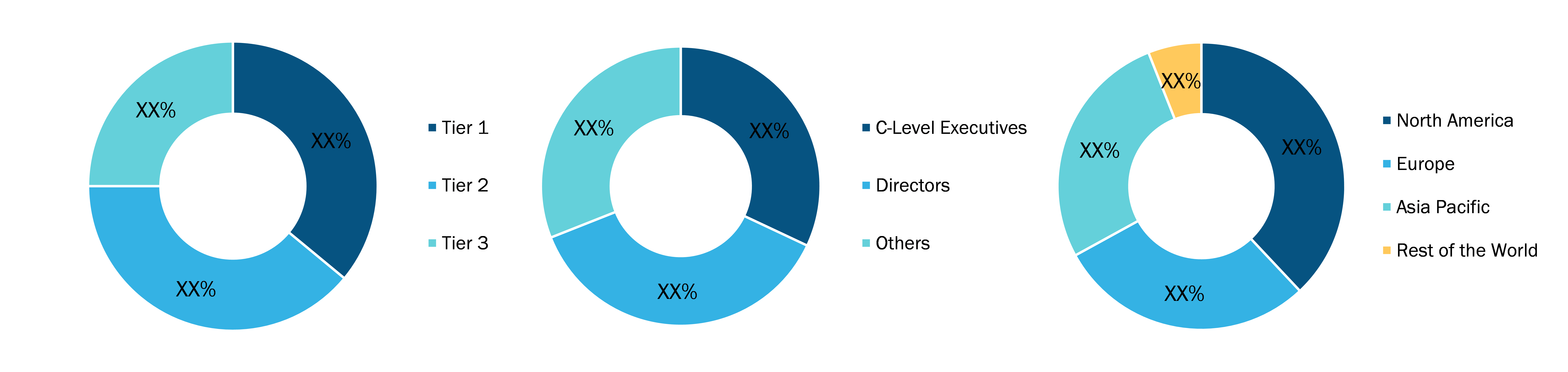
Once we receive the confirmation from primary research sources or primary respondents, we finalize the base year market estimation and forecast the data as per the macroeconomic and microeconomic factors assessed during data collection.
- Data Analysis:
Once data is validated through both secondary as well as primary respondents, we finalize the market estimations by hypothesis formulation and factor analysis at regional and country level.
- 3.1 Macro-Economic Factor Analysis:
We analyse macroeconomic indicators such the gross domestic product (GDP), increase in the demand for goods and services across industries, technological advancement, regional economic growth, governmental policies, the influence of COVID-19, PEST analysis, and other aspects. This analysis aids in setting benchmarks for various nations/regions and approximating market splits. Additionally, the general trend of the aforementioned components aid in determining the market's development possibilities.
- 3.2 Country Level Data:
Various factors that are especially aligned to the country are taken into account to determine the market size for a certain area and country, including the presence of vendors, such as headquarters and offices, the country's GDP, demand patterns, and industry growth. To comprehend the market dynamics for the nation, a number of growth variables, inhibitors, application areas, and current market trends are researched. The aforementioned elements aid in determining the country's overall market's growth potential.
- 3.3 Company Profile:
The “Table of Contents” is formulated by listing and analyzing more than 25 - 30 companies operating in the market ecosystem across geographies. However, we profile only 10 companies as a standard practice in our syndicate reports. These 10 companies comprise leading, emerging, and regional players. Nonetheless, our analysis is not restricted to the 10 listed companies, we also analyze other companies present in the market to develop a holistic view and understand the prevailing trends. The “Company Profiles” section in the report covers key facts, business description, products & services, financial information, SWOT analysis, and key developments. The financial information presented is extracted from the annual reports and official documents of the publicly listed companies. Upon collecting the information for the sections of respective companies, we verify them via various primary sources and then compile the data in respective company profiles. The company level information helps us in deriving the base number as well as in forecasting the market size.
- 3.4 Developing Base Number:
Aggregation of sales statistics (2020-2022) and macro-economic factor, and other secondary and primary research insights are utilized to arrive at base number and related market shares for 2022. The data gaps are identified in this step and relevant market data is analyzed, collected from paid primary interviews or databases. On finalizing the base year market size, forecasts are developed on the basis of macro-economic, industry and market growth factors and company level analysis.
- Data Triangulation and Final Review:
The market findings and base year market size calculations are validated from supply as well as demand side. Demand side validations are based on macro-economic factor analysis and benchmarks for respective regions and countries. In case of supply side validations, revenues of major companies are estimated (in case not available) based on industry benchmark, approximate number of employees, product portfolio, and primary interviews revenues are gathered. Further revenue from target product/service segment is assessed to avoid overshooting of market statistics. In case of heavy deviations between supply and demand side values, all thes steps are repeated to achieve synchronization.
We follow an iterative model, wherein we share our research findings with Subject Matter Experts (SME’s) and Key Opinion Leaders (KOLs) until consensus view of the market is not formulated – this model negates any drastic deviation in the opinions of experts. Only validated and universally acceptable research findings are quoted in our reports.
We have important check points that we use to validate our research findings – which we call – data triangulation, where we validate the information, we generate from secondary sources with primary interviews and then we re-validate with our internal data bases and Subject matter experts. This comprehensive model enables us to deliver high quality, reliable data in shortest possible time.

Jul 2025
Spark Detection System Market
Size and Forecast (2021 - 2031), Global and Regional Share, Trend, and Growth Opportunity Analysis Report Coverage: By Component [Infrared Spark Detection Systems and Ultraviolet (UV) Spark Detection Systems], Application (Wood-Based Panel Industry, Textile Industry, Pulp and Paper Industry, Bioenergy, Food Industry, and Others), and Geography (North America, Europe, Asia Pacific, Middle East and Africa, and South and Central America)
Jul 2025
Smart Casing Running Tools Market
Size and Forecast (2021 - 2031), Global and Regional Share, Trend, and Growth Opportunity Analysis Report Coverage: By Hardware [Remote Display, Sensor Kit (Torque and Tension Sensor, Position Sensor, Data Transmission Sensor, and Others), Head Assembly, Gripping Assembly, Circulator Assembly, Power Supply, and Other Accessories], Software (Inbuilt and Optional), Sales [Direct Sales and Aftermarket (Parts and Accessories and Service and Rental)], Application (Onshore and Offshore), Technology (Fully Automated CRT, Remotely Operated CRT, and Hybrid CRT), and Geography
Jul 2025
Room AC Market
Size and Forecast (2021-2031), Regional Share, Trend, and Growth Opportunity Analysis Report Coverage: By Product Type (Split AC, Window AC, and Portable AC), Technology (Inverter Technology and Non-Inverter Technology), End User (Residential and Commercial), and Geography
Jul 2025
Optical Measuring Machine Market
Size and Forecast (2021 - 2031), Global and Regional Share, Trend, and Growth Opportunity Analysis Report Coverage: By Equipment [Profile Projectors, Optical Digitizers and Scanners (ODSs), Coordinate Measuring Machines (CMMs), Measuring Microscopes, Video Measuring Machines (VMM) or Vision Measuring Systems, Profilometers, and Others], Optical Digitizers And Scanners (ODSS) Type (3D Laser Scanners, Structured Light Scanners and Laser Trackers), Application (Straight (Prismatic) Parts and Turned Parts), Turned Parts Type (Shafts, Bushings, Rings, and Others), Type (Contact and Noncontact), Industry Vertical (Automotive, Aerospace and Defense, Energy and Power, Electronics Manufacturing, Industrial, Medical, and Others), and Geography
Jul 2025
GNSS Chips for Timing and Synchronization Market
Size and Forecast (2021-2031), Global and Regional Share, Trend, and Growth Opportunity Analysis Report Coverage: by Device (Cellular Network Devices, Small Cells, PMR (Public Mobile Radios), Phazor Measurement Units (PMU), and Others), Industry Vertical (Telecom and IT, Energy, BFSI, Consumer Electronics, Automotive and Transportation, and Others), and Geography
 Get Free Sample For