Agricultural Biologicals Market Growth, Demand & Size by 2034
Agricultural Biologicals Market Size and Forecast (2021 - 2034), Global and Regional Share, Trend, and Growth Opportunity Analysis Report Coverage: By Type (Biopesticides, Biostimulants, Biofertilizers, and Others), Source (Microbials, Biochemicals, and Others), Application Mode (Foliar Spray, Soil Treatment, Seed Treatment, and Others), Application (Cereals and Grains, Oilseeds and Pulses, Fruits and Vegetables, and Others), and Geography (North America, Europe, Asia Pacific, Middle East and Africa, and South and Central America)
Historic Data: 2021-2024 | Base Year: 2025 | Forecast Period: 2026-2034- Status : Published
- Report Code : TIPRE00003668
- Category : Chemicals and Materials
- No. of Pages : 427
- Available Report Formats :



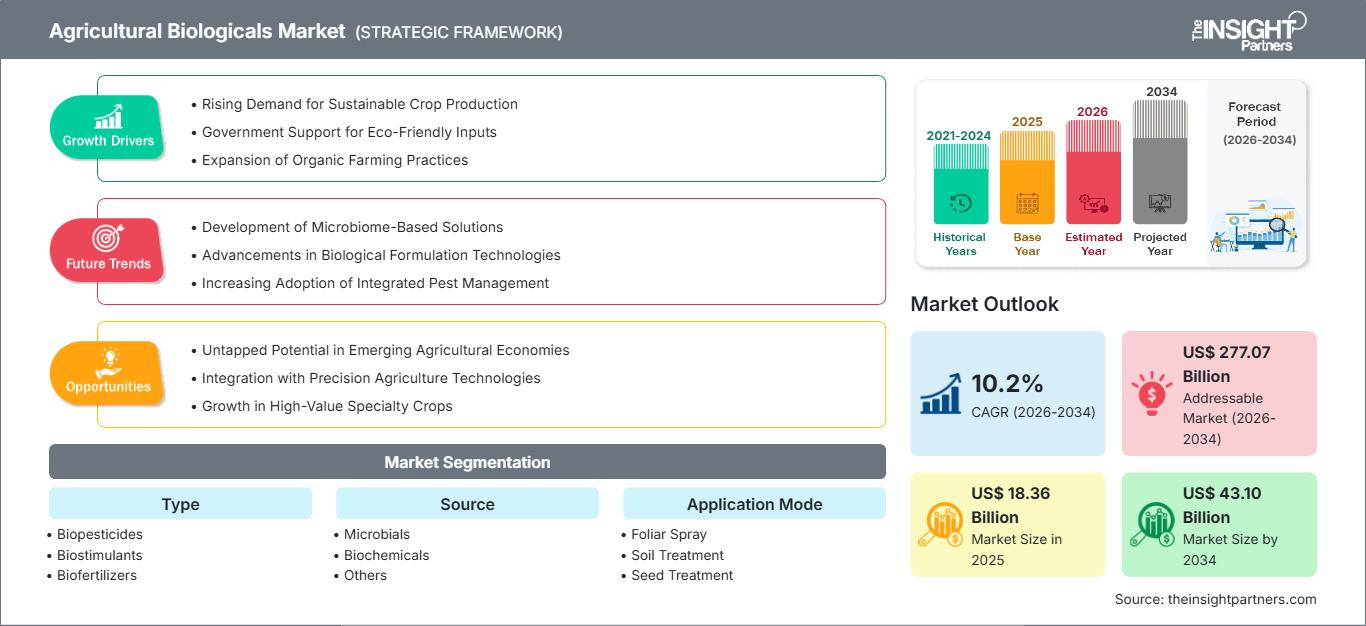
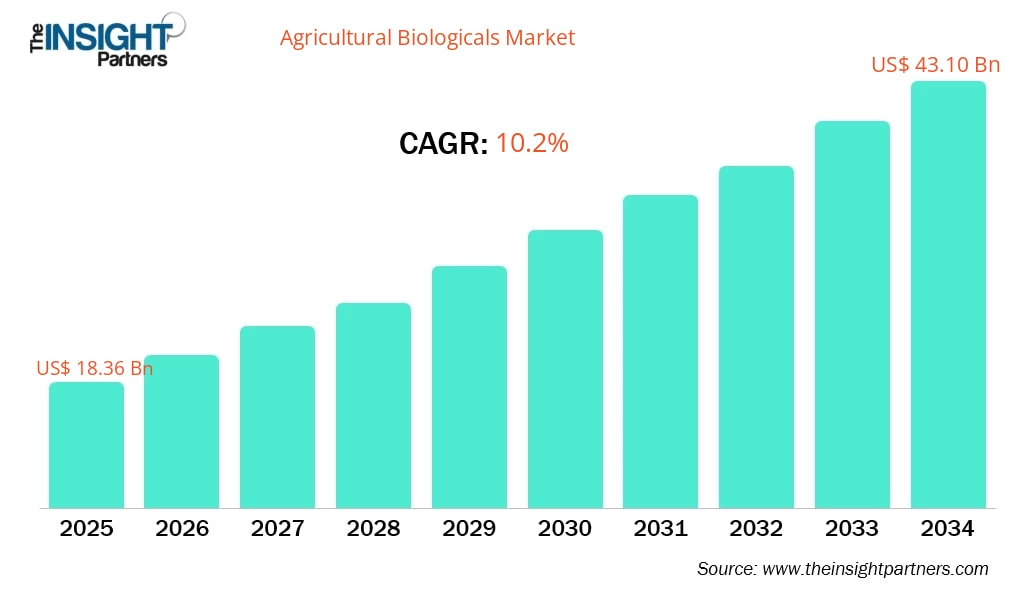
The agricultural biologicals market size is projected to reach US$ 43.10 billion by 2034 from US$ 18.36 billion in 2025. The market is expected to register a CAGR of 10.2% from 2026 to 2034.
Agricultural Biologicals Market Analysis
Agricultural biologicals such as biopesticides, biofertilizers, biostimulants, and microbial inoculants—use natural organisms and organic materials to boost crop growth, improve nutrient uptake, and increase resistance to pests and environmental pressures. Unlike traditional chemical inputs, they improve soil health, promote biodiversity, and support farm sustainability.
There is a stronger regulatory support for eco-friendly options. Consumer demand for organic and residue-free food is pushing farmers to use biological solutions in cereals, fruits, vegetables, and high-value specialty crops. Advances in strain development, formulation, and application methods have made these products more effective and reliable, leading to higher adoption rates.
Agricultural Biologicals Market Overview
Agricultural biologicals are natural products that aim to improve crop performance, boost soil health, and enhance resilience to environmental and biological stress. These inputs include microbial inoculants, biostimulants, biofertilizers, and biopesticides, which use beneficial bacteria, fungi, or plant-based compounds to support plant growth, increase nutrient availability, and protect against pests and diseases. By harnessing biological processes, these products offer an eco-friendly option compared to traditional chemical fertilizers and pesticides, promoting sustainable farming practices.
Agricultural biologicals can be used for various crop types due to their flexibility and ability to meet specific needs. In cereals and grains, they improve nutrient uptake, disease resistance, and yield consistency. In fruits and vegetables, they enhance fruit quality, shelf life, and stress tolerance while lowering chemical residue. Specialty crops, such as high-value horticultural and medicinal plants, benefit from biologicals by strengthening plant immunity, boosting metabolite content, and meeting organic or residue-free certification standards.
Customize This Report To Suit Your Requirement
Get FREE CUSTOMIZATIONAgricultural Biologicals Market: Strategic Insights
-
Get Top Key Market Trends of this report.This FREE sample will include data analysis, ranging from market trends to estimates and forecasts.
Agricultural Biologicals Market: Drivers and Opportunities
Market Drivers:
Organic farming limits or bans the use of synthetic fertilizers and pesticides, fueling demand for natural alternatives that support crop growth, soil health, and pest control. Agricultural biologicals provide eco-friendly solutions that meet the requirements for organic farming. As demand for organic food is increasing, farmers are using more biological inputs to boost yield, quality, and resilience while staying within organic standards. Using agricultural biologicals helps improve soil fertility, increase nutrient availability, and enhance plant immunity, which reduces reliance on chemical solutions. Advances in formulation, strain development, and application methods have made these products easier for organic growers to use. Supportive government policies, consumer preference for food without residues, and rising awareness of environmental sustainability are strengthening this trend.
Market Opportunities:
High-value specialty crops need careful nutrient management, better stress tolerance, and protection from pests and diseases to keep their quality and yield. Specialty crops, which include fruits, vegetables, nuts, herbs, and medicinal plants, are more sensitive to changes in the environment and chemical residues. This factor drives the demand for biologically based inputs that boost plant health while meeting food safety and organic standards.
Agricultural biologicals offer focused solutions for specialty crops. They help with nutrient uptake, improve resistance to pathogens, and increase tolerance to abiotic stress such as drought, salinity, or extreme temperatures. These products can enhance crop quality, affecting attributes like flavor, texture, shelf life, and metabolite content, which are crucial in high-value markets.
Agricultural Biologicals Market Report Segmentation Analysis
The agricultural biologicals market is divided into different segments to give a clearer view of how they work, their growth potential, and the latest trends. Below is the standard segmentation approach used in industry reports:
By Type
- Biopesticides: These are natural compounds or microorganisms used to control pests, diseases, and weeds. They protect crops without harming the environment, the way synthetic chemicals do, and work well with organic farming practices.
- Biostimulants: These products improve plant growth, nutrient uptake, and stress tolerance through natural bioactive compounds. They boost crop health, yield, and resilience against challenges such as drought or salinity.
- Biofertilizers: These are microbial or biochemical preparations that enhance soil fertility and provide essential nutrients to crops.
- Others: This category includes new or emerging biological products, such as plant extracts, beneficial insects, and enzymatic formulations.
By Source
- Microbials: These are live microorganisms, like bacteria or fungi, that improve plant health, nutrient availability, and resistance to disease.
- Biochemicals: These are natural compounds extracted from plants or microbes that promote growth, enhance stress tolerance, or guard against pests.
- Others: This category includes macrobials and other natural sources such as algae extracts, plant-derived proteins, or organic compounds that contribute to crop protection or growth improvement.
By Application Mode
- Foliar Spray: Agricultural biologicals are applied to plant leaves to improve nutrient uptake, induce resistance against pests and diseases, or stimulate growth.
- Soil Treatment: Biologicals are mixed into the soil to improve fertility, enhance microbial activity, and support root development and nutrient absorption.
- Seed Treatment: Products are applied to seeds before planting to protect against soil-borne pathogens, improve germination, and boost early plant vigor.
- Others: Alternative application methods include fertigation, trunk injection, or post-harvest sprays that provide targeted benefits for crops.
By Application
- Cereals and Grains: Biologicals are used to improve yield, nutrient efficiency, and disease resistance in crops such as wheat, rice, and maize.
- Oilseeds and Pulses: Products are applied to crops such as soy, sunflower, and lentils to improve soil fertility, growth, and stress resilience.
- Fruits and Vegetables: Biologicals enhance quality, shelf life, pest tolerance, and nutrient content in horticultural crops.
- Others: This category includes commercial crops, forage crops, and medicinal plants, where targeted biological methods improve performance and marketable quality.
By Geography
- North America
- Europe
- Asia Pacific
- South and Central America
- Middle East and Africa
Agricultural Biologicals Market Report Scope
| Report Attribute | Details |
|---|---|
| Market size in 2025 | US$ 18.36 Billion |
| Market Size by 2026-2034 | US$ 43.10 Billion |
| Global CAGR (2026 - 2034) | 10.2% |
| Historical Data | 2021-2024 |
| Forecast period | 2026-2034 |
| Segments Covered |
By Type
|
| Regions and Countries Covered |
North America
|
| Market leaders and key company profiles |
|
Agricultural Biologicals Market Players Density: Understanding Its Impact on Business Dynamics
The Agricultural Biologicals Market is growing rapidly, driven by increasing end-user demand due to factors such as evolving consumer preferences, technological advancements, and greater awareness of the product's benefits. As demand rises, businesses are expanding their offerings, innovating to meet consumer needs, and capitalizing on emerging trends, which further fuels market growth.
Agricultural Biologicals Market Share Analysis by Geography
North America dominates the agricultural biologicals market, driven by the growing demand for organic food diets. Emerging markets in South and Central America, the Middle East, and Africa have untapped opportunities for agricultural biologicals providers to expand.
The growth of the agricultural biologicals market varies by region. The focus on organic farming continues to grow, positioning agricultural biologicals in an evolving consumer landscape. Below is a summary of market share and trends by region:
1. North America
- Market Share: Dominates the market, with an annually rising market share
- Key Drivers:
- Increased adoption of sustainable and organic farming practices due to consumer demand for residue-free and organic food products.
- Trends: Use of precision agriculture and digital tools to improve biological application and monitor crop health.
2. Europe
- Market Share: Holds a significant market share
- Key Drivers:
- Strict regulations on chemical pesticides and fertilizers, pushing farmers to switch to eco-friendly alternatives.
- Trends: Rising use of biostimulants and microbial inoculants in high-value crops, such as fruits, vegetables, and vineyards.
3. Asia Pacific
- Market Share: Holds a significant market share
- Key Drivers:
- Growth of high-value specialty crops and large-scale commercial farming to meet rising food demand.
- Trends: Rapid development of locally adapted microbial strains and biofertilizers to match different climates and soil conditions.
4. South and Central America
- Market Share: A rapidly expanding market with consistent annual growth in market share
- Key Drivers:
- Emphasis on sustainable agriculture to enhance soil fertility and long-term productivity in staple crops like soy, maize, and sugarcane.
- Trends: Increased use of integrated crop management practices that combine biologicals with limited chemical inputs.
5. Middle East and Africa
- Market Share: Small market size expanding at a rapid pace
- Key Drivers:
- Growing focus on improving crop resilience in areas with water scarcity and arid climates.
- Trends: Creation and use of drought-tolerant biostimulants and microbial inoculants to aid agriculture in tough environments.
Agricultural Biologicals Market Players: Density: Understanding Its Impact on Business Dynamics
High Market Density and Competition
Competition is intense due to the presence of established players such as BASF SE, Corteva Inc, UPL Ltd, Syngenta AG, Bayer AG, and Koppert BV.
This high level of competition urges companies to stand out by offering:
- Diverse product offering
- Sustainable and ethical sourcing
- Competitive pricing models
- Strong customer support and easy integration
Opportunities and Strategic Moves
- Companies are focusing on research and development activities to distinguish themselves in the market.
- Leading agrochemical companies are expanding their global footprint and capabilities through strategic acquisitions of manufacturers in the sector.
- Key players are expanding their product portfolio with the launch of organic products.
Other companies analyzed during the course of research:
- BASF SE
- Corteva Inc
- UPL Ltd
- Syngenta AG
- Bayer AG
- Koppert BV
- Biolchim SpA
- Yara International ASA
- New Edge Microbials Pty Ltd
- AGROBEST AUSTRALIA PTY. LTD.
Agricultural Biologicals Market: News and Recent Developments
- BASF – Mergers and Acquisitions: In January 2026, BASF Agricultural Solutions acquired AgBiTech, a company that specializes in biological insect control, from Paine Schwartz Partners and other shareholders. This purchase is expected to provide BASF with full ownership of AgBiTech's portfolio, intellectual property, manufacturing, research and development facilities, and staff. The deal is expected to be finalized in the first half of 2026, pending regulatory approval, but the financial details have not been disclosed.
- BASF – Expansion: In May 2025, BASF aimed to grow its agriculture unit in Asia and expand in the global seed market as it prepares for a stock market listing in two years. This unit includes seeds, traits, seed treatment products, biological and chemical crop protection solutions, and digital farming products.
Agricultural Biologicals Market Report Coverage and Deliverables
The "Agricultural Biologicals Market Size and Forecast (2021–2034)" report provides a detailed analysis of the market covering the following areas:
- Agricultural Biologicals Market size and forecast at global, regional, and country levels for all the segments covered under the scope
- Agricultural Biologicals Market trends, as well as dynamics such as drivers, restraints, and key opportunities
- Detailed Porter's five forces and SWOT analysis
- Agricultural Biologicals Market analysis covering key trends, global and regional framework, major players, regulations, and recent developments
- Industry landscape and competition analysis covering market concentration, heat map analysis, prominent players, and recent developments for the agricultural biologicals market
- Detailed company profiles
Frequently Asked Questions

- Historical Analysis (2 Years), Base Year, Forecast (7 Years) with CAGR
- PEST and SWOT Analysis
- Market Size Value / Volume - Global, Regional, Country
- Industry and Competitive Landscape
- Excel Dataset
Recent Reports
Testimonials

The Insight Partners' SCADA System Market report is comprehensive, with valuable insights on current trends and future forecasts. The team was highly professional, responsive, and supportive throughout. We are very satisfied and highly recommend their services.
RAN KEDEM Partner, Reali Technologies LTDs
I requested a report on a very specific software market and the team produced the report in a few days. The information was very relevant and well presented. I then requested some changes and additions to the report. The team was again very responsive and I got the final report in less than a week.
JEAN-HERVE JENN Chairman, Future Analytica
We worked with The Insight Partners for an important market study and forecast. They gave us clear insights into opportunities and risks, which helped shape our plans. Their research was easy to use and based on solid data. It helped us make smart, confident decisions. We highly recommend them.
PIYUSH NAGPAL Sr. Vice President, High Beam Global
The Insight Partners delivered insightful, well-structured market research with strong domain expertise. Their team was professional and responsive throughout. The user-friendly website made accessing industry reports seamless. We highly recommend them for reliable, high-quality research services
YUKIHIKO ADACHI CEO, Deep Blue, LLC.
This is the first time I have purchased a market report from The Insight Partners.While I was unsure at first, I visited their web site and felt more comfortable to take the risk and purchase a market report.I am completely satisfied with the quality of the report and customer service. I had several questions and comments with the initial report, but after a couple of dialogs over email with their analyst I believe I have a report that I can use as input to our strategic planning process.Thank you so much for taking the extra time and making this a positive experience.I will definitely recommend your service to others and you will be my first call when we need further market data.
JOHN SUZUKI President and Chief Executive Officer, Board Director, BK Technologies
I wish to appreciate your support and the professionalism you displayed in the course of attending to my request for information regarding to infectious disease IVD market in Nigeria. I appreciate your patience, your guidance, and the fact that you were willing to offer a discount, which eventually made it possible for us to close a deal. I look forward to engaging The Insight Partners in the future, all thanks to the impression you have created in me as a result of this first encounter.
DR CHIJIOKE ONYIA MANAGING DIRECTOR, PineCrest Healthcare Ltd.Reason to Buy
- Informed Decision-Making
- Understanding Market Dynamics
- Competitive Analysis
- Identifying Emerging Markets
- Customer Insights
- Market Forecasts
- Risk Mitigation
- Boosting Operational Efficiency
- Strategic Planning
- Investment Justification
- Tracking Industry Innovations
- Aligning with Regulatory Trends



 Get Free Sample For